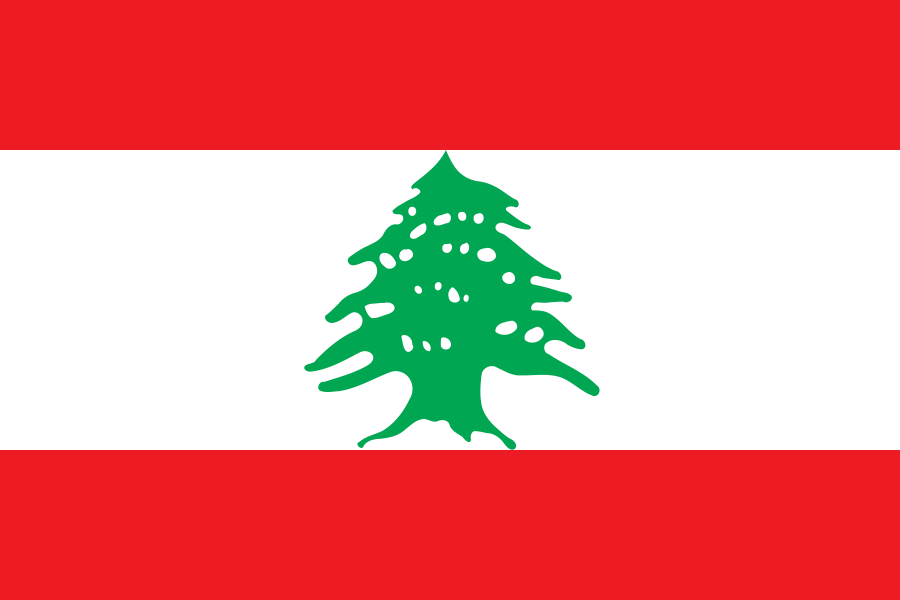
It's amazing how many times I've been asked "Where's Beirut?" or "Where is Lebanon?" and even "Beirut? That's in Germany right?".
Lebanon is an Arab state on the eastern Mediterenean. Dwarfed by it much larger neighbour, Syria, little Lebanon also shares it southern border with Israel. That border, however, The country is only about 10,000 square kms (as a point of comparison for Malaysians, the state of Perak is about twice the size). The current population of Lebanon is approximately 4 million, but the country also hosts almost a million Syrian refugees. (Naturally this influx has put a lot of pressure on the country and its resources, while the conflict in Syria has had the unfortunate destabilizing effect on Lebanon.)
Beirut is the capital and the home of the country's only airport.
 |
| Approaching Beirut |
Lebanon has a long and rich history. The Phoenicians, creators of the phonetic alphabet, were lived in this early. The Biblical cities of Sidon and Tyre are in Lebanon. The famous cedars Solomon used to build the temple in Jerusalem were from Lebanon. This land was at various points in history controlled by the Assyrians, Persians, Greeks, Romans, Arabs, the Crusaders, Ottomans and French. Each left its mark on the land and its people. There is no escaping the fact that this region IS history and one of the cradles of human civilization. So I travelled over 16,000 km from New Zealand, one of the last places on earth to be populated by humankind, to where it all began. Reckon that's cool.
Lebanon's history and location at the crossroads of Europe and the Middle East is visible in its modern day diversity. It is the most religiously diverse country in the Middle East. The CIA World Factbook estimates that in 2014, the population is 54% Muslim (Sunni and Shia), 40.5% Christian (Maronite Catholic, Greek Orthodox, Greek Catholic, and other Christian), Druze 5.6%, and a tiny number of Jews, Baha'is, Buddhists and Hindus. These figures are just estimates as there hasn't been a census in Lebanon since the 1930s. When the census was last taken, Christians formed a slight majority, but it is estimated that their numbers have declined against the Muslim population due to different birthrates and migration patters. (The religious percentages come as quite a surprise to many people I talk to - everyone seems to assume that Middle East = Arab + Muslim + deserts. One lady I spoke to in Auckland had difficulty comprehending when I told her that Lebanon is by the Mediterenean. And while I'm debunking myths - no, I do not have to wear a headscarf.) On the topic of migration, there is a very large Lebanese diaspora. Estimates indicate that there are more people of Lebanese descent overseas (6 million?) than in Lebanon.
 |
| Beirut beach on a weekend |
